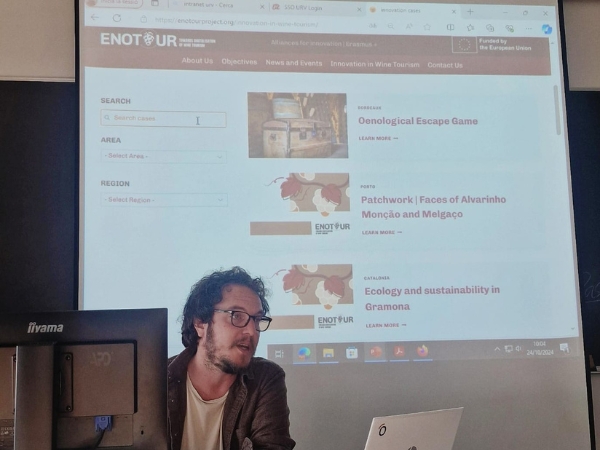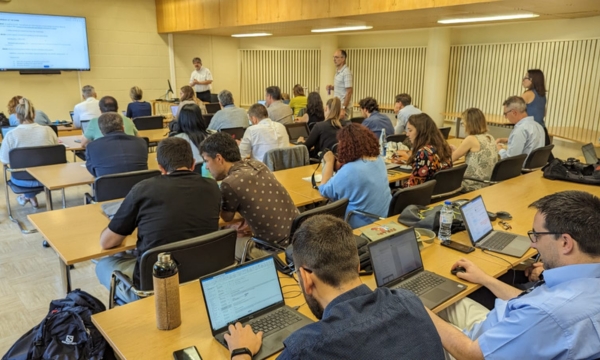
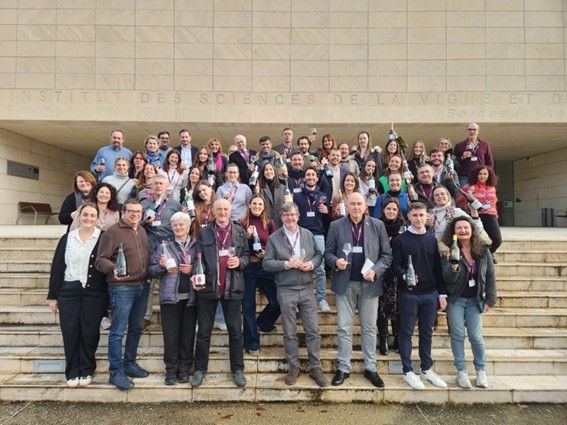
Bordeaux (France), 4–5 December 2025. As part of its third year of implementation, ENOTOUR organised its first results dissemination event, focusing on innovation, digitalisation and local development in the wine tourism sector.
Over the course of two days, 61 participants attended in person and 23 online, including the four universities participating in the project—the Rovira i Virgili University (ENOTOUR coordinator), the Université de Bordeaux, the Università degli Studi di Padova, and the University of Porto; the four vocational education and training (VET) centres—the Instituto do Cávado e do Ave, the Escola d’Enoturisme de Catalunya, the Lycée Gascogne, and the Escola Profissional de Vila do Conde; the four consortium companies—Gramona, Vignobles de Larose, Massimago, and Quinta do Portal—, as well as the technical partners of the project: Obreal and Eurecat.
Among the participants were representatives of tourism organisations from the regions of Penedès, Veneto, Porto, and Bordeaux, as well as 25 wineries from different European territories. These stakeholders exchanged experiences and knowledge on current challenges in the sector and on the technologies transforming the way wine destinations are visited and communicated.
The wineries that participated on site, grouped by region, were as follows: from Penedès, Gramona, El Jardí dels Sentits, Freixenet, Rovellats, Sumarroca, and Suriol; from Veneto, Vidor, Bortolomiol, Castello Bonomi, Massimago, Paladin, and Perlage; from the Porto region, Vinevinu, Sogrape, Fita Preta Vinhos, Casa de Algar, Churchill, and Quinta do Portal; and from Bordeaux, Château Couhins, Château Pédesclaux, Château Lilian Ladouys, Château Lafon-Rochet, Château Giscours, Château Haut-Bailly, and Vignobles de Larose.
Special mention should be made of Lo Nostre Arròs, which, although not a winery, participated in the event by presenting innovations in rice-based liqueurs and beers.
In addition, the event included the participation of representatives from the Consorci de Promoció Turística del Penedès, the Regione del Veneto, the Associação Portuguesa de Enoturismo, the Conseil Interprofessionnel du Vin de Bordeaux, Oenotourisme et Réseaux Internationaux – CCI Bordeaux Gironde, as well as the Valpolicella Wine Route, the Bordeaux Wine Route, and the Great Wine Capitals network.
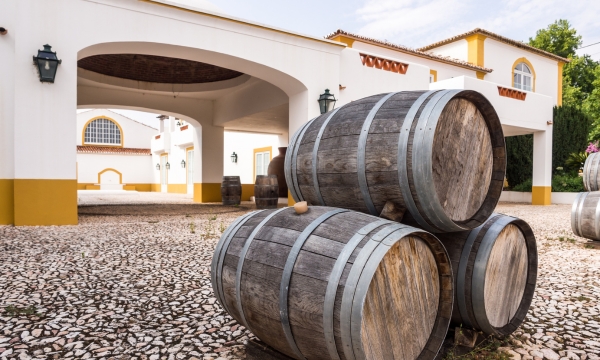
Held at the Institute of Vine and Wine Sciences (ISVV) of the University of Bordeaux, the event combined plenary sessions, round tables, co-creation activities, and a technical visit to Château Larose Trintaudon, where examples of innovation applied to the tourism experience, digital storytelling, and sustainable management of wine heritage were presented.
Within the framework of the event, the main tools developed by the ENOTOUR project were presented, including specialized training courses in wine tourism, self-assessment tools for wineries, and a virtual experience creation manager. Participating companies were invited to incorporate these tools into their innovation portfolios for wine tourism development.
This initiative aims to expand the reach of the project and facilitate the incorporation of new companies into the ENOTOUR partnership, in line with the approved work plan.
The activity, which complies with the requirements set out in the project’s Grant Agreement, significantly exceeded the minimum expected attendance and generated new opportunities for collaboration between wineries, educational institutions, and public stakeholders. For its part, Universitat Rovira i Virgili contributed its expertise in tourism planning, digitalization, and destination governance, as well as its perspective on professionalizing the sector through digital marketing tools and learning methodologies adapted to the new professional profiles emerging in wine tourism. According to Salvador Anton Clavé, General Coordinator of the project, “this event has made it possible to highlight the key role of innovation in wine tourism as a driver of local and regional development and transformation, while strengthening a European collaborative network that directly contributes to the competitiveness and sustainability of wine-producing regions.”