



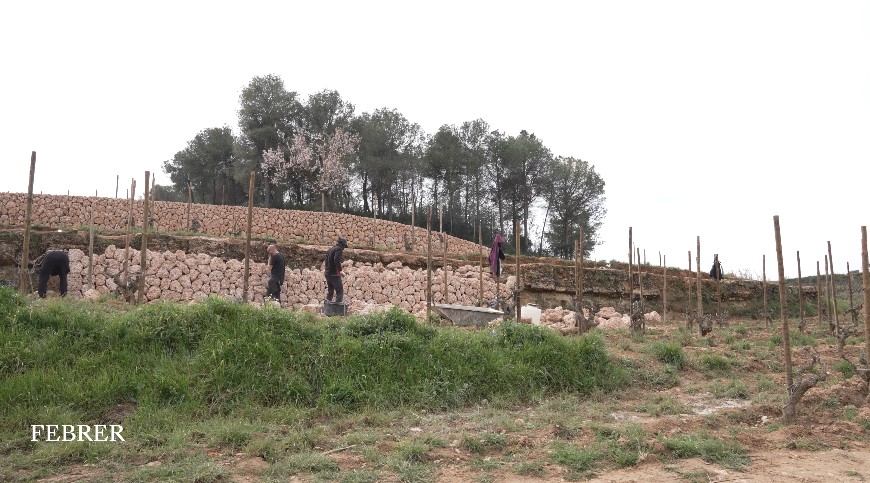
Expert builders, heirs to an ancestral technique passed down from generation to generation, are currently working on the restoration of terraces, walls, stepped pathways, and vineyard huts that form an essential part of the rural territory. These constructions, built without mortar, have for centuries played a key role in the organisation of agricultural land. Dry stone terraces and walls allow plots to be consolidated into stepped fields, especially on sloping terrain, preventing soil erosion, the loss of water, and the leaching of nutrients. Thanks to their permeable design, rainwater slowly filters through the structure, enhancing soil fertility and contributing to a sustainable ecological balance. Beyond their agricultural utility, these structures create microhabitats that promote biodiversity. Between the stones, small birds, insects, reptiles, and a wide range of micro-life find shelter, contributing to the natural balance of the environment. Thus, what originally emerged as an ingenious solution for agricultural survival has also become a valuable ecological system. Today, dry stone constructions represents our history, culture, and identity. Its recovery not only protects material heritage but also a traditional know-how that connects past, present, and future. In the context of climate change, its conservation takes on new meaning as an example of sustainability and respect for the landscape.